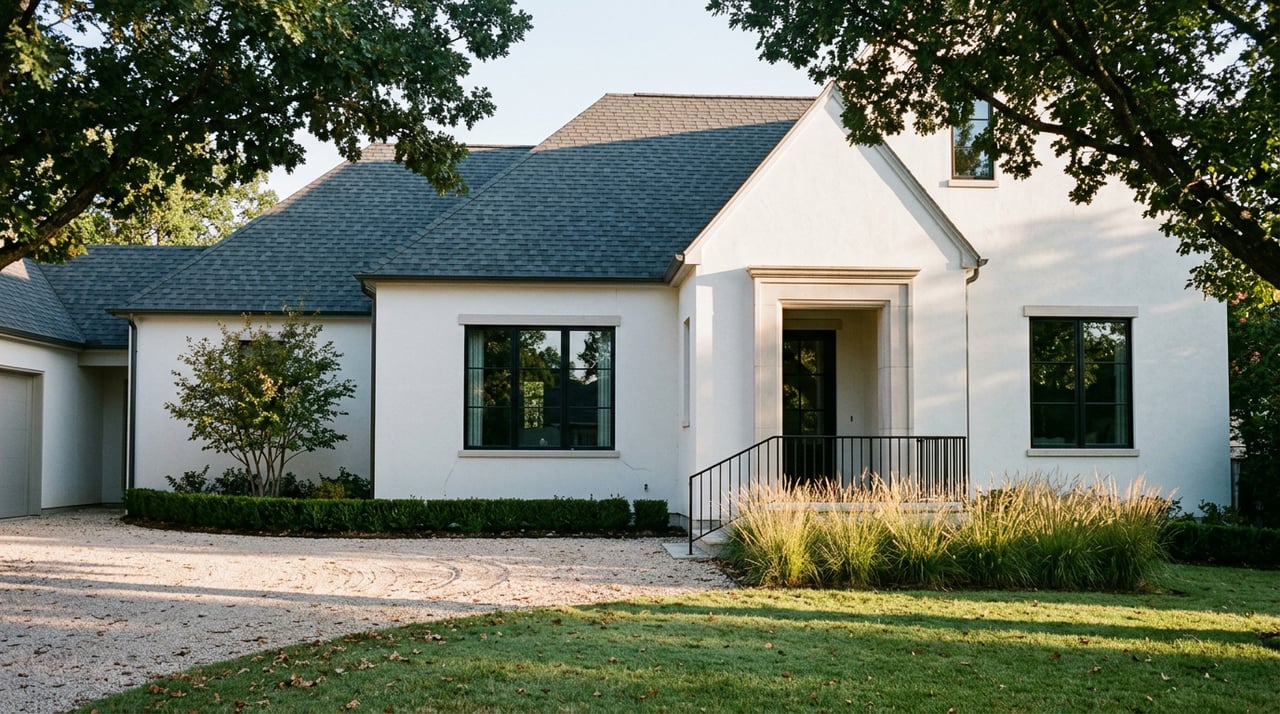
Cherry Hills Village High Line Canal Trail Updates for Fall 2026
September 10, 2026
September 10, 2026
The orange sign appeared sometime in the last few weeks, propped against the railing where the High Line Canal Trail crosses onto the Quincy Farm bridge. It's the kind of detour notice that would barely register on a city sidewalk with six other routes around it. In Cherry Hills Village, it stops people mid-stride, because there isn't another route. There's the canal, and then there's everything else.
That's not an accident of geography. When Cherry Hills Village incorporated in 1945, the founding idea was residential character preserved by design, with no commercial development allowed inside the boundary. No strip of shops, no downtown block, no plaza where neighbors run into each other buying groceries. The High Line Canal Trail, a soft-surface gravel path that predates the village itself, ended up doing the job a Main Street usually does. It's where people walk dogs, run before work, and see the same faces on a Tuesday morning that they saw on Sunday. Segment 13 of the trail, labeled "Pastoral Cherry Hills Village" on the official map, runs 2.9 miles from the Belleview Avenue area down to Three Pond Park, and it's the only piece of public infrastructure in the village that functions like a commons.
This fall, that commons has more happening on it at once than usual, and understanding why explains something about how this particular neighborhood gets maintained.
The bigger of the two active projects is at Quincy Farm, the 17.5-acre historic property that sits on both sides of the canal. The farm was gifted to the city by Catherine "Cat" Anderson upon her death in 2015. Since late 2021, the city has partnered with Cherry Hills Land Preserve, a local nonprofit founded in 2005, to revitalize the property. In 2025, that partnership finished a multi-year renovation of the property's 1934 barn. The next project in line is the farm's pond, which the city describes as shallow and suffering from poor water quality, visited by herons and other birds but not deep enough to support a healthy habitat. A $241,000 grant from Arapahoe County Open Space is funding a dredging project to make the pond smaller and deeper, with nesting boxes and bat boxes added afterward.
The contractor is completing that dredging and earthwork this fall, then coming back in spring to reseed the banks, plant wetland plugs, and add trees. During the dredging phase, the trail can close during the day for trucking operations, with a short detour posted and flaggers on site. That's the sign by the bridge.
The second project is smaller but sits entirely inside village limits. The High Line Canal Conservancy has been working with the city on an irrigation line along the canal to keep newly planted trees alive, and in 2026 that line is being extended north of Belleview Avenue with additional trees planted in partnership with the conservancy. It's not a closure so much as a slow, visible thickening of the tree canopy along one more stretch of the path.
Neither project is disruptive on the scale of a road closure. But because the canal is the only through-route, and because Quincy Farm doesn't allow dogs or bikes on the property itself, funneling all foot and bike traffic onto the trail, even a partial-day detour touches a much larger share of daily movement than the same closure would somewhere with parallel streets to duck onto.
Here's what to expect through the rest of the season:
Part of what makes the detour notable is that the trail through Cherry Hills Village is usually the smoothest stretch of the whole 71-mile canal. The city installed underpasses beneath Hampden Avenue and Colorado Boulevard specifically so runners and cyclists could pass beneath both roads without breaking stride. Most of the 71-mile trail requires crossing at grade somewhere. This segment doesn't, which is part of why it draws equestrians, dog walkers doing two-mile loops before the rest of the village wakes up, and commuters cutting through on the way to the Denver Tech Center.
A path that's built to be interruption-free is the one place where a temporary interruption gets noticed. It's the same reason a pothole on a highway feels more disruptive than one on a gravel road you already drive slowly.
If the canal is the village's substitute for a Main Street, it's been missing something a Main Street usually has: somewhere to stop. That changed in January 2026, when Lavender Coffee Boutique opened its second full-service café at 1400 E. Hampden Avenue, right on the village's northern edge. The company's flagship location on South Pearl Street had built a following in Platt Park, and this was its first expansion. Before it opened, the nearest widely listed full-service coffee option was more than two miles away, according to the company's own account of the location search.
The Cherry Hills café opens at 6:30am, half an hour earlier than the Pearl Street location, timed for people running the canal before work or heading into the Tech Center by 8am. Founder Lindsey Sozio has described wanting to build cafes as "spaces and experiences that remind us of the importance of human interaction and our connectedness," which is a fairly direct answer to a village that has spent eighty years designing out the kind of commercial gathering spot most neighborhoods take for granted. It's a single café, not a corridor of them, but for a place with zero other retail inside its lines, one café on the border does a lot of the same work a small commercial strip would do elsewhere.
The Quincy Farm pond project and this fall's tree planting both trace back to the same nonprofit, Cherry Hills Land Preserve, which also throws the farm's biggest annual fundraiser. This year's Barn Party is set for Friday, September 18, 2026, with live music, barbecue, and a silent auction inside the renovated barn. It's the kind of event that reads as a party but functions as the funding mechanism behind everything described above. In the 2025 season, the organization ran 27 educational programs at the farm, from birding walks with Denver Audubon volunteers to flower arranging workshops in the barn, drawing more than 1,600 visits over the year. The Barn Party is where a meaningful share of that comes from.
By the time the party wraps up, the pond dredging should be finished for the season, with the trail detour signs coming down until the contractor returns in spring for planting. The tree line north of Belleview will keep filling in gradually through 2026 and into next year, one irrigation extension at a time.
None of this changes the basic fact of the neighborhood: no storefronts, no downtown, one trail doing the work of a town square. What's different this particular fall is that the trail is getting the kind of investment usually reserved for a Main Street, funneled through a nonprofit, a county grant, and a nonprofit party in a barn instead of a business improvement district. It's a slower, quieter version of the same thing, which tracks for a village that was built to move at that pace in the first place.
If you're weighing what a home along this stretch of the canal is actually worth, given the trail work, the new café anchor, and the way this segment differs from the rest of the 71-mile path, Antoinette Bradley has spent years reading Cherry Hills Village at exactly this level of detail. Reach out to schedule a free consultation.
Stay up to date on the latest real estate trends.
The journey of buying or selling a home is personal, and Antoinette believes in guiding every client with expertise, care, and transparency. Drawing from her early real estate successes and entrepreneurial experience, she empowers clients to make confident, strategic decisions.